
Bespoke CRM development
Model the relationships, stages, owners and next actions your team actually uses, with an interface focused on daily work.
Trayaam provides custom CRM development services for UK and India teams whose relationship workflows need more than a spreadsheet. We shape a bespoke CRM around your companies, contacts, sales pipeline and follow-ups, and compare configuration with a custom build before committing to either.
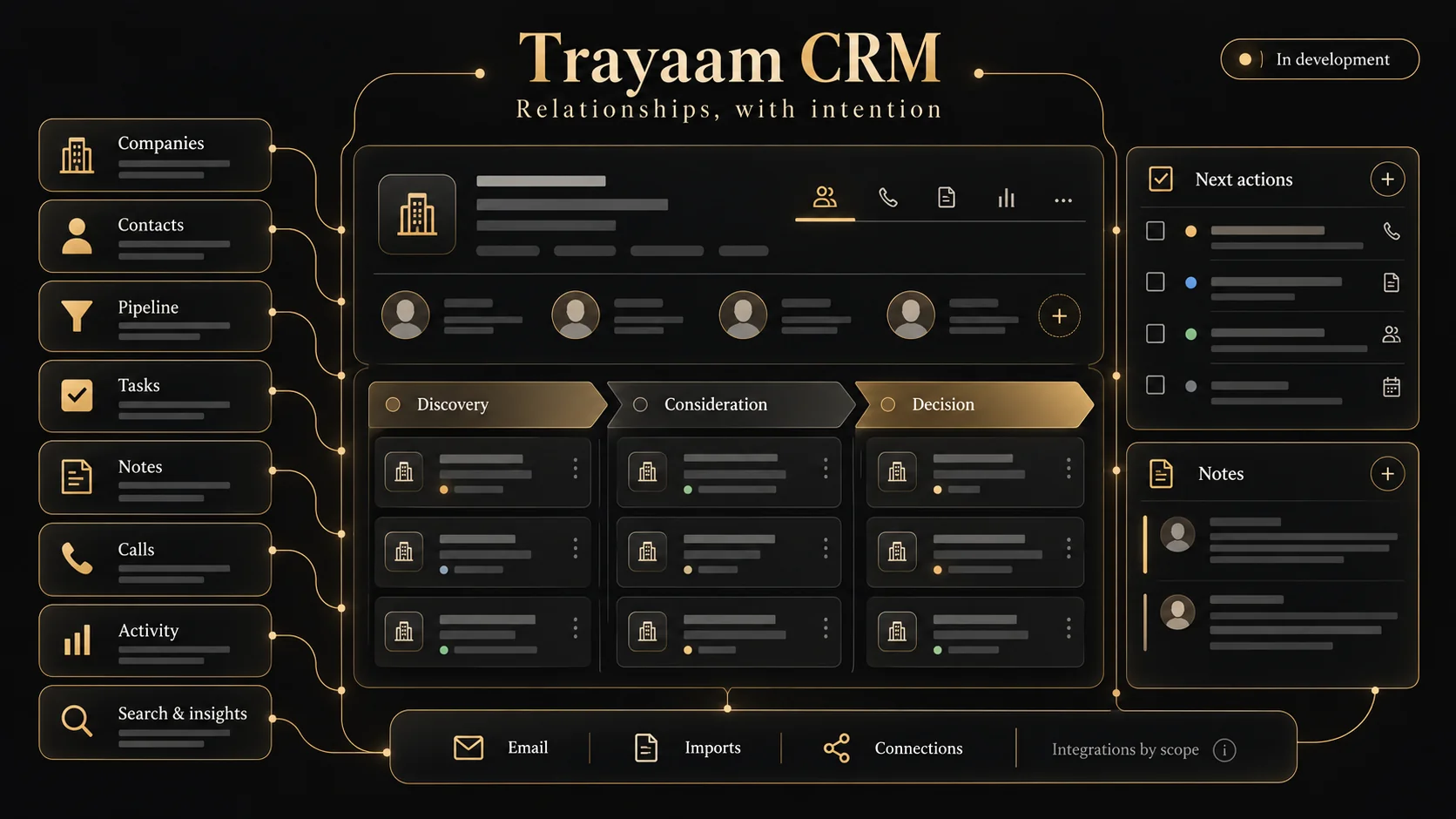
Model the relationships, stages, owners and next actions your team actually uses, with an interface focused on daily work.
Connect company context to opportunities and tasks so the next step has an owner and a place in the workflow.
Plan data mapping, imports and website enquiry routing. Email, calendar and other provider connections are agreed and tested separately.
For teams managing relationships across spreadsheets, notes and disconnected tools, or needing a workflow their current CRM cannot support.
Discuss your project →Link people to organisations, record relationship context and make the next action easy to find.
Model your stages, assign follow-ups and keep activity history attached to the relationship.
Define useful stage and activity reports with clear data sources, rather than decorative dashboard numbers.
Plan email, calendar, imports and other connections separately, including provider access, permissions and testing.
Discovery: map workflows, constraints and the first useful release.
Scope: agree deliverables, price, milestones and acceptance criteria.
Build: review working increments and test representative scenarios.
Launch: validate migration, deployment, handover and support.
Excel is a spreadsheet that can hold contacts and a simple sales tracker. A dedicated CRM adds a relationship model, shared activity context and structured follow-ups. If ownership, duplicate records or next actions are becoming hard to manage, assess a CRM against those specific problems.
A common grouping is operational, analytical, collaborative and strategic CRM. These describe different emphases: managing activity, understanding data, sharing customer context and planning relationships. Products often combine them, so choose around the work your team needs to do.
The cost follows the data model, workflows, user roles, migration, reporting and integrations. We scope a first useful release and quote the agreed deliverables. Hosting, provider subscriptions, maintenance and future changes belong in the ownership budget as well.
Configure an established CRM when it meets your essential workflows with reasonable effort. Consider bespoke CRM development when the relationship model, handovers or integrations remain poorly served. Compare setup, licences, customisation, maintenance and exit costs over the same period.
Start with company and contact records, clear ownership, useful pipeline stages and follow-up tasks. Add reporting and integrations when they support an agreed decision or handover. A smaller coherent workflow is easier to validate than a long feature list.
Website-to-CRM lead capture can be included in the scope. We agree the fields, permissions, consent requirements, ownership rules and failure handling, then test the route with your chosen tools. The connection needs acceptance testing before it handles live enquiries.
Migration can cover agreed records after a safe sample review. We define field mappings, deduplication rules, ownership and validation, then rehearse an import before cutover. Sensitive customer data should stay out of the public preview.
Trayaam CRM is in final development, with a read-only interface preview available now. We offer discovery and scoped implementation. The public preview uses sample records; production access, persistent data and live connections have separate release checks.
A prototype can demonstrate records and workflows. Production acceptance also needs real identity and permissions, persistence, integration failure handling, monitoring, recovery and support ownership. Our public CRM preview demonstrates the interface; it does not establish those live release checks.
The agreement should name responsibility for hosting, updates, dependencies, backups, incident handling and future changes. Source-code ownership alone is not an operating plan. We identify those responsibilities and ongoing costs during scoping.
Tell us what you use today, where work gets stuck and what a useful first release would change.
Plan your implementation →A usable CRM needs more than a dashboard. Use a representative enquiry-to-follow-up workflow to compare an existing product, configured software and a custom build.
Write down capture, qualification, ownership, next action and reporting. Trial that same scenario in an existing CRM before paying to rebuild functionality it already supports.
Include setup, seats, migration, integrations, hosting, maintenance and exit costs. A custom application transfers ongoing operating responsibility; it does not automatically remove subscription or support costs.
Define who can view, change, export or delete records. Test role boundaries with representative accounts and establish how a restore will be checked in the deployment environment.
Email, calendars and website forms need provider permission, mapping and failure handling. A demonstration of the interface does not establish that a live connection is ready.
For websites, ERP and CRM projects, we agree security checks around the application's data, users and integrations. Our CRM development already includes automated negative tests for access rules, invalid requests, unsafe configuration and backup integrity.
Local tests are one layer. Deployment checks, any agreed independent testing, fixes and retests form a separate release review before handover.
See our security and handover process →