
Manufacturing ERP implementation
Bring bills of materials, work orders, stock entries and production planning into an agreed manufacturing workflow.
Trayaam provides ERPNext implementation services and custom ERP development for businesses in the UK and India. Connect manufacturing, inventory, purchasing and reporting around an agreed operational workflow, with configuration and customisation chosen to fit your team.
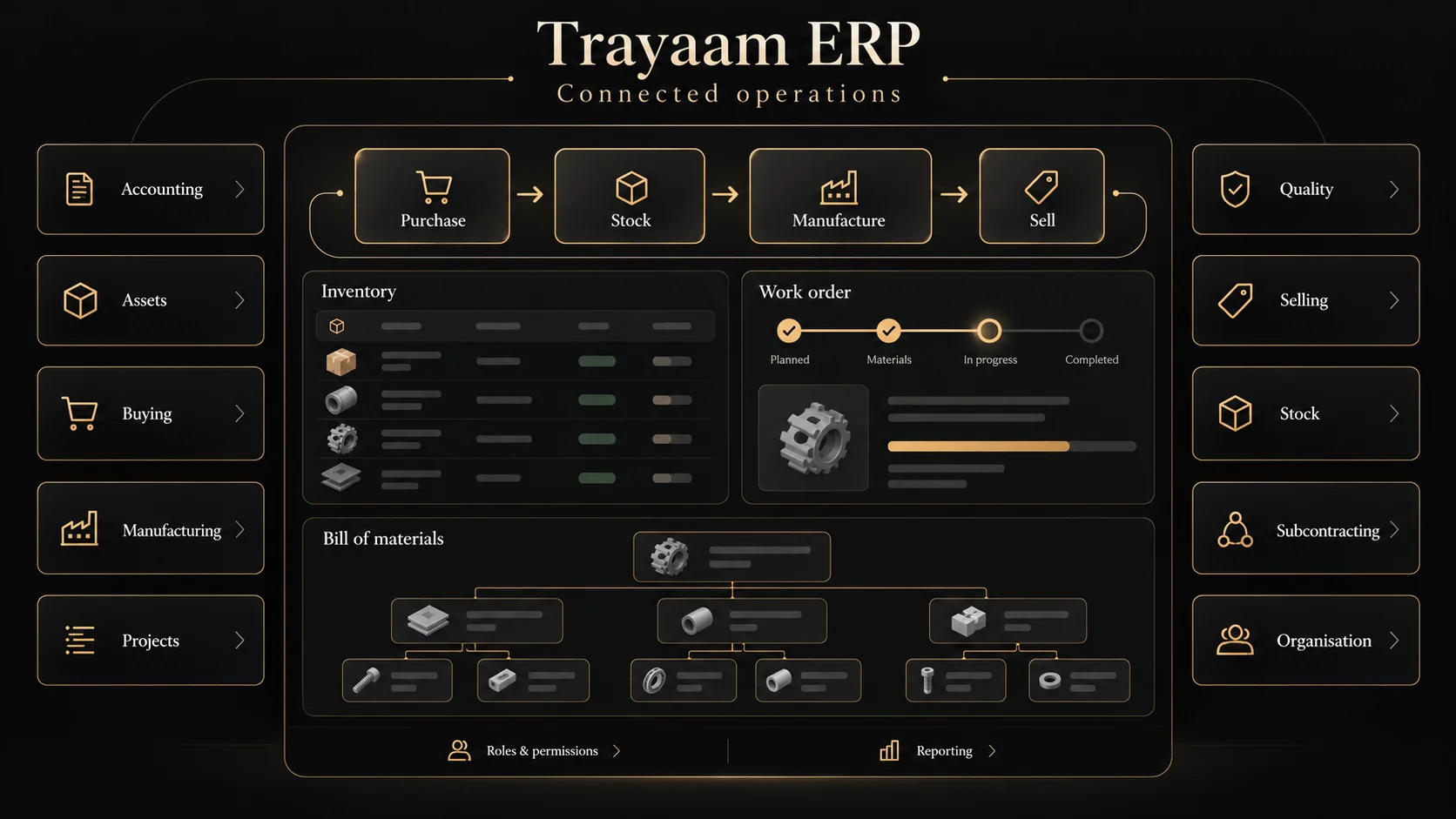
Bring bills of materials, work orders, stock entries and production planning into an agreed manufacturing workflow.
Start with standard ERPNext modules. Add custom fields, approvals or integrations where a documented business requirement calls for them.
Map item, supplier and operational records, rehearse imports and check the results before an agreed cutover.
For businesses whose operational process has outgrown disconnected spreadsheets and off-the-shelf workarounds.
Discuss your project →Map the people, records and approvals involved before choosing modules or writing software.
Scope inventory, purchasing, orders, production or reporting around your priorities. Each module is agreed separately.
Review existing spreadsheets and systems, define field mappings, validate imports and retain a recovery path.
Define roles, access rules and reports, then test them with the people who use the system.
Discovery: map workflows, constraints and the first useful release.
Scope: agree deliverables, price, milestones and acceptance criteria.
Build: review working increments and test representative scenarios.
Launch: validate migration, deployment, handover and support.
Implementation cost depends on the modules, data quality, customisation, integrations, training and rollout. ERPNext is open-source, but hosting, implementation and support still need a budget. We review your workflow and provide a written scope and quote; a hosting price is not the total project cost.
The right choice depends on process fit, complexity, existing integrations, support and total ownership cost. We assess the workflows and controls your team needs before recommending a platform. A feature checklist alone cannot decide which ERP is better for your business.
An agreed engagement can cover discovery, module configuration, data preparation, roles, workflow testing, user training and launch handover. Custom development, third-party connections, hosting and ongoing support are identified separately in the scope.
ERPNext includes manufacturing workflows such as bills of materials, work orders, production planning and stock movements. Your implementation needs to validate the relevant workflow against your products, units, approvals and reporting requirements. Our ERP case study shows the workspace we use to explore that fit.
The schedule follows the first agreed release, data readiness and team availability. A focused module rollout and a multi-department migration have different requirements. We set milestones for configuration, trial migration, acceptance testing and launch after discovery.
Yes, migration can be scoped after reviewing a safe sample. We agree field mappings, record ownership and validation rules, rehearse the import and retain a recovery path. Historical data and opening records may need different treatment.
Ask for a relevant walkthrough, a written module scope, a migration and acceptance plan, named support responsibilities and clear code or configuration ownership. Check claimed certifications independently and compare the whole delivery proposal rather than a headline hosting fee.
An ERP connects operational work such as purchasing, stock and production. A CRM focuses on relationships, opportunities and follow-ups. Start with the workflow causing the most friction; connect both systems when a defined handover justifies the integration.
Do not assume zero downtime. Review the source systems, data volume and critical operating hours, then agree a migration rehearsal, any read-only period, reconciliation and a rollback decision. The release plan should state the disruption the business has accepted.
The specification should define alerts, retries, duplicate prevention and a manual recovery path. Acceptance tests should cover interrupted requests and conflicting updates as well as successful transfers. The exact implementation depends on the agreed systems.
Tell us what you use today, where work gets stuck and what a useful first release would change.
Plan your implementation →Compare proposals against the same operational workflow, not just a module list. Configuration, migration and the work after launch all affect the decision.
Name the departments, locations, roles, reports and integrations included. Demonstrate one complete process, such as purchase to stock receipt, before expanding the rollout.
Agree field mappings, duplicate rules, opening balances and reconciliation totals. Rehearse with safe data, record exceptions and define who approves the cutover or rollback.
Specify which system owns each field, sync direction and frequency, retry behavior and duplicate prevention. A successful API connection alone does not prove that records stay consistent.
Separate implementation from hosting, licences, upgrades, backups and support. Agree administrator access, configuration documentation and the process for adding a module later.
For websites, ERP and CRM projects, we agree security checks around the application's data, users and integrations. Our CRM development already includes automated negative tests for access rules, invalid requests, unsafe configuration and backup integrity.
Local tests are one layer. Deployment checks, any agreed independent testing, fixes and retests form a separate release review before handover.
See our security and handover process →